
Measuring for a kitchen backsplash is one of those home improvement steps that sounds simple but can quickly become confusing. You might wonder which parts of your wall to include, how to deal with outlets and windows, or whether it’s best to buy extra material.
Getting the measurements right is not just about buying enough tile—it’s about making sure your kitchen looks polished and professional, and you avoid wasting money or running short. Whether you’re preparing for a DIY tiling project or handing measurements to a contractor, learning how to measure correctly will save you time, stress, and money.
This guide walks you through every detail, so you can approach your kitchen backsplash project with confidence.
Why Proper Measurement Matters
Many homeowners underestimate the importance of accurate measurements when planning a backsplash. A backsplash is more than a decorative accent—it protects your walls from splashes, stains, and heat. If you measure incorrectly, you risk buying too much or too little material, which means wasted money or project delays. Poor planning can also lead to awkward tile cuts, uneven lines, and a less professional finish.
For example, if you miss measuring the area behind your stove or around a window, you might have to order more tile and pay extra shipping. On the other hand, overestimating could leave you with boxes of unused tiles. Even a half-inch mistake can show up as a visible gap or awkward grout line.
This is why accuracy is your best friend when planning a backsplash.
What You Need Before You Start
Before you pull out the measuring tape, gather these tools:
- Measuring tape (at least 12 feet)
- Pencil and paper or a notepad
- Level (bubble or laser)
- Calculator
- Straightedge or ruler
- Camera or phone (to take photos for reference)
- Graph paper (optional, for sketching layouts)
- Step stool or ladder (if you have tall cabinets)
Make sure the kitchen area is clean and clear. Remove any items from the countertops and wipe down the walls. This makes it easier to measure and spot any obstacles.
Understanding Your Backsplash Area
A kitchen backsplash typically covers the wall space between the countertop and the upper cabinets. Sometimes, it extends behind the stove or up to the ceiling, especially for bold designs. Before measuring, decide exactly where you want the backsplash to go.
Standard Backsplash Heights
- 4-inch backsplash: Often used with granite or quartz countertops; a small strip along the wall.
- Full-height backsplash: Extends from the countertop to the bottom of the upper cabinets (usually 18 to 24 inches high).
- Counter-to-ceiling backsplash: Covers the area between the counter and the ceiling, often behind the stove or sink for a dramatic effect.
Knowing these options helps you plan your measurements. Measure each section separately if your kitchen layout is complex.
Step-by-step: How To Measure For A Kitchen Backsplash
Let’s break down the process into clear, manageable steps.
1. Sketch Your Kitchen Wall
Start by drawing a simple outline of your kitchen wall on paper. Include:
- Outlines of countertops
- Upper and lower cabinets
- Windows and doors
- Appliances (stove, fridge, etc.)
- Electrical outlets and switches
You don’t need to be an artist—just a rough sketch to help you organize your measurements. Take a quick photo of your kitchen for reference. This step helps you visualize the backsplash area and anticipate any tricky spots.
2. Measure The Width Of Each Section
Use your measuring tape to measure the width of each backsplash section:
- Place the tape at one end of the countertop and stretch it to the other end, right beneath the upper cabinets.
- Write down the measurement to the nearest 1/8 inch.
- If your backsplash runs along multiple walls, measure each wall section separately.
Example
If your kitchen has two walls forming an L-shape, measure each wall’s width and note them separately.
3. Measure The Height Of The Backsplash
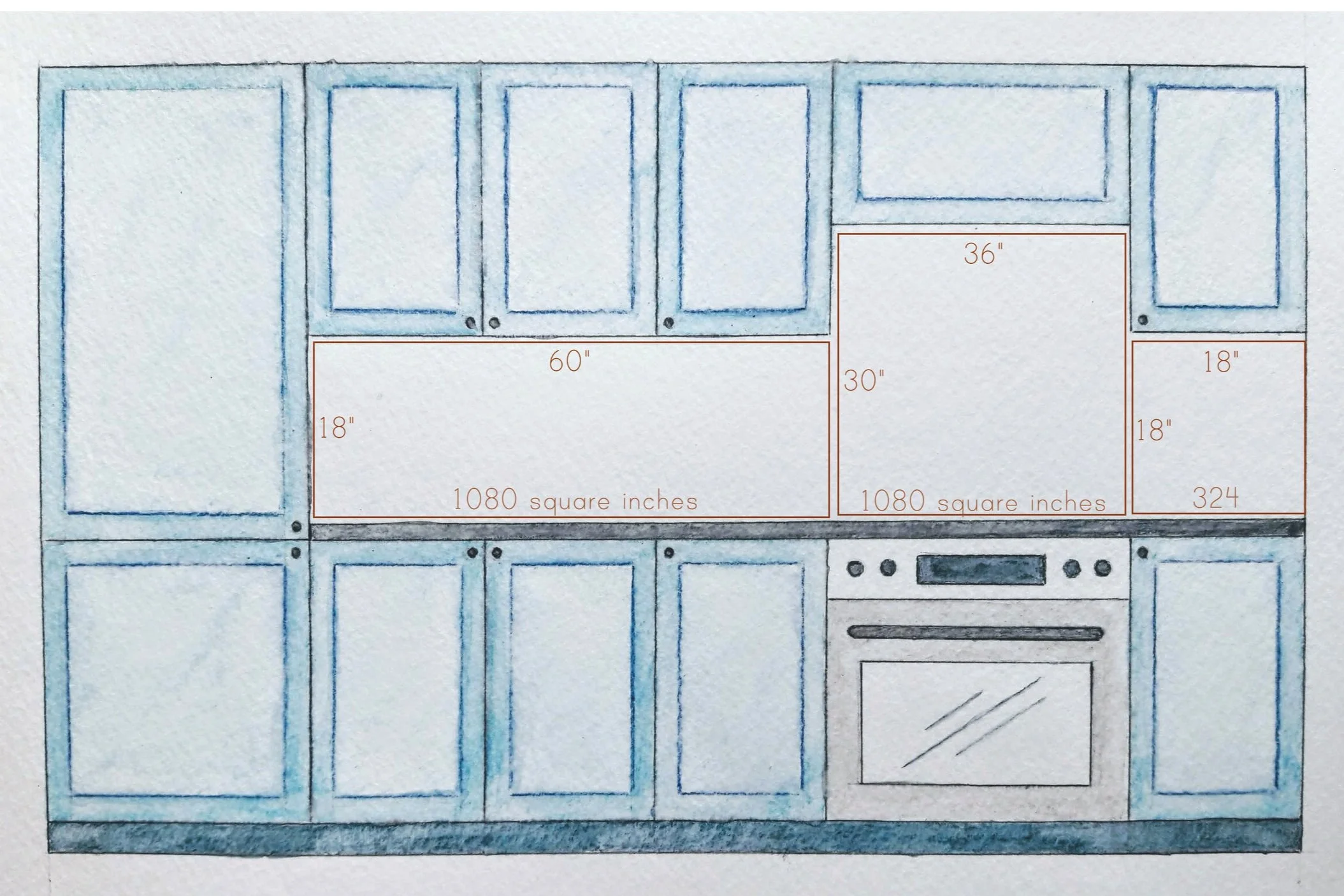
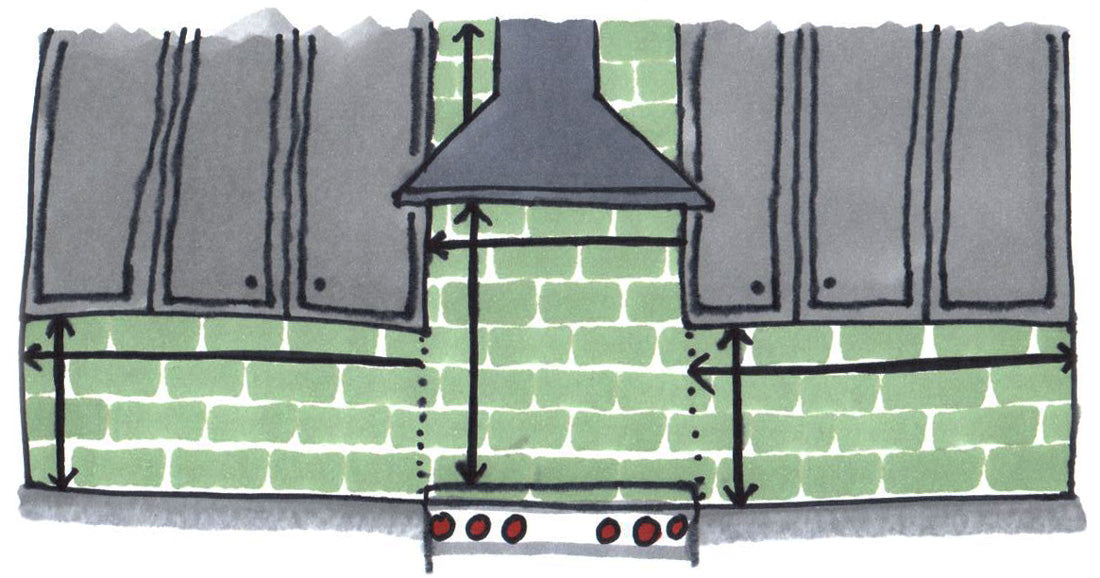
Measure from the countertop to the bottom of the upper cabinets. This is usually between 18 and 24 inches but can vary. If you have a section with no upper cabinets (for example, behind the stove or a window), measure from the countertop to the ceiling or the bottom of any vent hood.
Write down each height measurement clearly.
4. Calculate The Area
For each section, multiply the width by the height to get the area in square inches. Then, convert to square feet (divide by 144).
Example Calculation
- Section 1: 60 inches wide x 18 inches high = 1080 square inches
- 1080 / 144 = 7.5 square feet
Repeat for each wall or section. Add all the areas together for your total backsplash area.
5. Subtract Windows, Doors, And Large Obstacles
If your backsplash area includes windows or doors, subtract their area so you don’t buy extra material.
- Measure the width and height of the window or door.
- Multiply for the area, then subtract from your total.
Example
- Window: 36 inches wide x 18 inches high = 648 square inches
- 648 / 144 = 4.5 square feet
If your total backsplash area was 25 square feet, subtract 4. 5 to get 20. 5 square feet.
6. Consider Outlets And Switches
You don’t need to subtract the area of electrical outlets or switches; they are small, and you’ll need to cut tiles around them anyway. However, make a note of their positions on your sketch. This helps you plan where you’ll need to make cuts and avoid placing small tile slivers next to outlets.
7. Add Overage For Waste
Always add 10–15% extra to your total area. This covers:
- Cutting mistakes
- Tile breakage
- Pattern matching (if using patterned or mosaic tiles)
- Future repairs
To do this, multiply your total area by 1. 1 or 1. 15.
Example
- Total area: 20.5 square feet
- Overage: 20.5 x 1.15 = 23.58 square feet
Round up to the nearest box or sheet, depending on how your tile is packaged.
8. Double-check Every Measurement
This step seems obvious, but it’s where most mistakes happen. Measure each section again, confirm your calculations, and make sure your notes are clear. If someone else will help install the backsplash, show them your notes and measurements to confirm everything makes sense.
Dealing With Corners, Odd Angles, And Special Areas
Not all kitchens are simple rectangles. Here’s how to handle more complex shapes and features.
Measuring Around Corners
If your kitchen backsplash wraps around a corner, measure each wall separately. For inside corners, make sure to measure all the way to the edge of the wall, not just to the corner.
Angled Or Sloped Ceilings
If you have a sloped ceiling above your backsplash (for example, in an attic kitchen), divide the area into rectangles and triangles:
- Measure the rectangular part as usual.
- For the triangle, measure the base and the height, then use the formula:
(base X Height) / 2 = Area
Backsplash Behind The Stove
Many kitchens have a feature wall behind the stove that goes to the ceiling or vent hood. Measure the width and full height of this area separately and include it in your total.
Open Shelving Or No Upper Cabinets
If you have open shelves or no upper cabinets, measure from the countertop to the lowest shelf or to the ceiling. Decide if you want the backsplash to end at the shelf or go all the way up.
Windows Within The Backsplash
If a window is inside your backsplash area (for example, behind the sink), measure as if the window wasn’t there, then subtract the window’s area. Be careful around window trim and sills, as you may need to cut tiles to fit.
How To Measure For Different Backsplash Materials
Not all backsplash materials are the same. The way you measure and buy can change depending on your choice.
Standard Tile
Most backsplash tiles are sold by the square foot. The steps above will give you the right total. Buy in full boxes if possible, as dye lots can vary.
Mosaic Sheets
Mosaic tiles usually come in sheets (often 12×12 inches, or 1 square foot). Measure your area in square feet to know how many sheets to buy.
Large Format Tiles
If using large tiles (like subway tiles or glass panels), measure as above. Pay extra attention to the layout, so you don’t end up with thin slivers at the edges.
Peel-and-stick Tiles
These often come in packs or sheets. Measure your total area, then check the packaging for coverage per sheet.
Stone Or Slab Backsplashes
If you plan to use a slab of stone (like granite or marble), measure carefully and give your measurements to the fabricator. They will need exact dimensions for cutting.

Credit: mercurymosaics.com
Example Project: Measuring A U-shaped Kitchen
Let’s walk through an example with a U-shaped kitchen:
- Back wall: 80 inches wide, 20 inches high
- Left wall: 50 inches wide, 20 inches high
- Right wall: 50 inches wide, 20 inches high
- Window on back wall: 30 inches wide, 20 inches high
- Measure each wall’s area:
- Back: 80 x 20 = 1600 sq in
- Left: 50 x 20 = 1000 sq in
- Right: 50 x 20 = 1000 sq in
- Add together: 1600 + 1000 + 1000 = 3600 sq in
- Convert to square feet: 3600 / 144 = 25 sq ft
- Subtract window: 30 x 20 = 600 sq in; 600 / 144 = 4.17 sq ft
25 – 4.17 = 20.83 Sq Ft
- Add 15% overage: 20.83 x 1.15 = 23.95 sq ft
Buy 24 square feet of tile (round up to the next box).
Common Mistakes To Avoid
Even careful DIYers can make mistakes. Here are some pitfalls:
1. Not Adding Extra For Waste
Skipping the overage means you might run out of tile if a few break or the pattern doesn’t match perfectly.
2. Measuring Only The Length Of The Wall
Always include the height for an accurate area.
3. Forgetting Windows, Outlets, Or Special Features
Not subtracting large windows or measuring around obstacles can lead to buying too much or too little material.
4. Incorrectly Handling Odd Shapes
Divide complex areas into rectangles and triangles for easier calculations.
5. Ignoring Tile Layout
If your tiles are large, check how they’ll fit on the wall. You may need more cuts or extra tiles if the layout isn’t ideal.
6. Relying On Memory
Always write down your measurements and double-check them.
7. Not Checking Tile Packaging
Some tiles are sold by the box or by the piece. Check coverage before buying.
Data Comparison: Material Needs By Backsplash Type
How much tile do you need for common kitchen layouts? Here’s a quick comparison:
| Kitchen Style | Average Backsplash Area (sq ft) | Recommended Overage (sq ft) | Total to Purchase (sq ft) |
|---|---|---|---|
| Small galley | 12 | 2 | 14 |
| L-shape | 18 | 2.7 | 20.7 |
| U-shape | 25 | 3.75 | 28.75 |
| Full wall (feature) | 30 | 4.5 | 34.5 |
These are averages—always measure your specific kitchen.
How To Plan Tile Layout And Patterns
After measuring, think about how your tiles will fit on the wall.
Horizontal Or Vertical Layout
Most tiles are installed horizontally, but a vertical layout can make a kitchen look taller. Measure carefully to see how many tiles fit in each direction.
Pattern Matching
If you choose a tile with a repeating pattern (like a Moroccan or herringbone design), plan for extra waste. Patterns often require more cuts and careful placement.
Avoiding Small Slivers
Try to avoid ending a row with a very thin tile. Adjust your starting point or the size of the grout lines to keep edge tiles at least half the width of a full tile.
Credit: www.lilyworktile.com
Handling Outlets, Switches, And Obstacles
Every kitchen has electrical outlets, switches, or fixtures in the backsplash area. Here’s how to deal with them:
- Mark their exact position on your sketch.
- Measure the distance from the edge of the countertop and from the wall.
- Plan for tile cuts around these areas—add a bit extra to your order in case of mistakes.
If you have a large fixture (like a pot filler or a wall-mounted faucet), measure carefully around it. It’s better to have extra tile for these tricky spots.
How To Record And Organize Your Measurements
Staying organized saves time and reduces errors.
- Use a dedicated notebook for your kitchen project.
- Clearly label each measurement (for example: “Left wall, height = 18 in”).
- Sketch your layout and write the measurements directly on the drawing.
- Take photos of each wall and label them for reference.
If you’re working with a contractor, share your notes, sketches, and photos.
Credit: mercurymosaics.com
Quick Reference: Measurement Conversion Table
For easy reference, here’s how to convert inches to square feet:
| Inches | Square Inches | Square Feet |
|---|---|---|
| 12 x 12 | 144 | 1 |
| 24 x 18 | 432 | 3 |
| 36 x 18 | 648 | 4.5 |
| 48 x 20 | 960 | 6.67 |
| 60 x 18 | 1080 | 7.5 |
This helps you quickly check your math.
Tips For A Smoother Measurement Process
Here are a few practical ideas many beginners miss:
1. Check For Wall Irregularities:
Not all walls are perfectly flat or straight. Use a level to check for bulges or dips. If the wall isn’t straight, measure at several points and use the largest number.
2. Account For Grout Lines:
If you want very thin grout lines, your measurements can be tighter. For wide grout lines, you may need slightly less tile.
3. Match Tile Dye Lots:
Tiles from different boxes can have slight color differences. Buy all your tiles at once and check the dye lot numbers.
4. Consider Future Repairs:
Buy a few extra tiles for future repairs. If a tile cracks, you’ll have a perfect match.
5. Ask Your Supplier:
If you’re unsure, bring your measurements and layout to the tile store. Staff can help confirm your math and suggest how much to buy.
Visualizing Your Backsplash With Design Tools
If you want to see how your backsplash will look, many tile companies and design websites offer online visualizers. You can upload a photo of your kitchen and try different tile patterns and colors. This isn’t necessary for measuring, but it helps with planning and confidence.
When To Call A Professional
Measuring for a backsplash is a DIY-friendly task, but in some cases, professional help is wise:
- If your kitchen walls are very uneven or damaged
- If you plan to install a heavy stone or glass slab
- If you want a complex pattern that needs expert layout
Even if you hire a pro, understanding the measurement process helps you communicate clearly and avoid misunderstandings.
Extra Insight: What Most Guides Don’t Tell You
Most measurement guides overlook a few practical realities:
- Tile thickness matters: If your backsplash will butt up against window trim, a stove, or a cabinet edge, check how thick your tile is. Thicker tiles need more space, and you may need to adjust trim or caulk lines.
- Check backsplash start and end points: Decide exactly where your backsplash will start and stop—aligned with cabinets, centered under a hood, or extending past a counter edge. Mark these spots on the wall before measuring.
These small details make a big difference in the final look.
Final Checklist Before You Buy
Before purchasing your backsplash material, run through this quick checklist:
- [ ] All wall sections measured, including tricky spots
- [ ] Heights and widths written down clearly
- [ ] Sketches and photos completed
- [ ] Large windows/doors subtracted from area
- [ ] Outlets and switches marked on your plan
- [ ] 10–15% overage added for waste
- [ ] Tile layout considered (horizontal/vertical/pattern)
- [ ] Measurements double-checked
Taking time here saves headaches later.
Frequently Asked Questions
How Do I Measure For A Kitchen Backsplash With A Window?
Start by measuring the full backsplash area as if the window was not there. Then, measure the width and height of the window and subtract that area from your total. Remember to measure carefully around the window trim and sill, as you may need to cut tiles to fit.
Mark the window’s position on your sketch for reference.
Should I Add Extra Tile For Waste, And How Much?
Yes, always add 10–15% extra to cover waste from cutting, breakage, and pattern matching. For example, if your calculated area is 20 square feet, buy at least 22–23 square feet of tile. It’s better to have a few leftover tiles for future repairs than to run out during installation.
What Should I Do If My Walls Are Not Perfectly Straight?
If your walls are uneven or not straight, measure at several points along the length and height. Use the largest numbers for your calculations. This ensures you’ll have enough material to cover the widest and tallest parts of the wall.
Do I Need To Subtract The Area Of Outlets And Switches?
No, you don’t need to subtract outlets and switches from your total backsplash area. These are small, and you will need to cut tiles around them anyway. Just make sure to mark their positions on your sketch and plan for careful cuts.
Can I Use An Online Calculator To Check My Measurements?
Yes, many tile supplier websites offer online calculators where you can enter your measurements to check your math. However, it’s important to understand the manual process as well, so you can double-check and adjust for special features. For accurate results, always measure by hand first and use the calculator as a confirmation.
For more information on home improvement measuring tips, visit Home Depot’s guide.
Measuring your kitchen backsplash accurately is the foundation for a beautiful, lasting result. Take your time, double-check your numbers, and don’t hesitate to ask for help if you need it. With careful planning, your kitchen will look polished and inviting for years to come.