
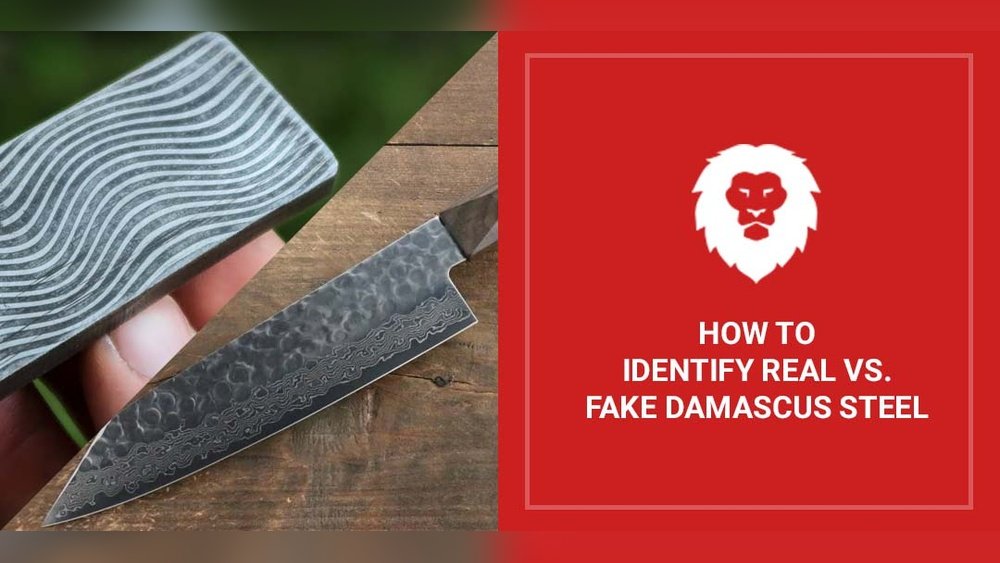
Many knife lovers dream of owning a real Damascus knife. The patterns, the history, and the reputation for toughness make Damascus steel legendary. But when you decide to buy one, it’s not easy to know if you’re looking at true Damascus steel or just a fake with a pretty surface. The market is full of knives with Damascus “patterns,” but not all of them are genuine. Some are only etched or printed to look like the real thing.
This creates confusion for buyers, whether you’re a collector, a chef, or just starting with knives. Genuine Damascus steel is not just about looks; it’s about the process, performance, and value. If you want to make sure you’re getting the real deal, you need to understand what makes Damascus steel special and how to spot the fakes.
In this guide, you’ll discover clear ways to tell if a knife is real Damascus. You’ll learn about its history, the science behind the steel, and practical steps to check a knife’s authenticity. You’ll also get tips on what questions to ask sellers, how to avoid common mistakes, and why it’s important to be careful with your investment. By the end, you’ll feel confident to judge Damascus knives like an expert.
What Is Real Damascus Steel?
Damascus steel is famous for its distinctive wavy patterns, but there’s more to the story. Real Damascus steel was first made over 2,000 years ago in the Middle East and India. It was used to create swords and knives that were both beautiful and extremely strong. The original process used a special type of steel called wootz, which is now lost to history.
Today, when people talk about Damascus knives, they usually mean pattern-welded steel. This is made by forging layers of different steels together, folding, and hammering them until they bond. The result is a blade with visible layers and complex patterns that go all the way through the steel, not just on the surface.
Real Damascus knives are valued because:
- The patterns are created by the forging process, not printed or etched.
- The layers combine the strengths of different steels.
- Skilled makers control the process, creating both art and high performance.
Many fakes look convincing, but they don’t have the same construction or qualities.
Why Are There So Many Fake Damascus Knives?
The popularity of Damascus knives has led to a flood of lookalikes on the market. Many are made to look beautiful but are not made with real layered steel. There are a few reasons for this:
- Cheaper production: True Damascus requires skill, time, and good materials, which makes it expensive. Fake versions can be made faster and sold for less.
- Demand for patterns: Many buyers focus on the patterns, not the steel quality, so sellers take shortcuts.
- Confusing terms: Some sellers use words like “Damascus pattern” or “Damascus style” to describe etched or printed designs, which can trick buyers.
A 2022 knife industry report estimated that over 60% of “Damascus” knives sold online are not real pattern-welded steel. Some are simply acid-etched carbon steel, while others are laser-printed or use decals.
This is why it’s so important to know what you’re looking for and how to check a knife’s authenticity.
How Is Real Damascus Steel Made?
True Damascus steel is a result of careful pattern welding. Here’s how the process usually works:
- Stacking steels: The maker chooses two or more types of steel with different properties. They are stacked in layers.
- Heating and forging: The stack is heated to high temperatures and hammered together until the layers bond.
- Folding and twisting: The billet may be folded, twisted, or cut and restacked to create complex patterns.
- Shaping: The steel is forged into the shape of the knife.
- Etching: The blade is dipped in an acid bath to bring out the contrast between layers.
- Finishing: The blade is polished, sharpened, and fitted with handles.
The result is a blade with strong, visible layers from the edge to the spine. Each knife is unique, and the patterns cannot be exactly repeated.
Visual Clues: How To Spot Real Damascus Patterns
When you look at a knife, the pattern is the first thing you see. Here are ways to tell if those patterns are genuine:
Layer Depth
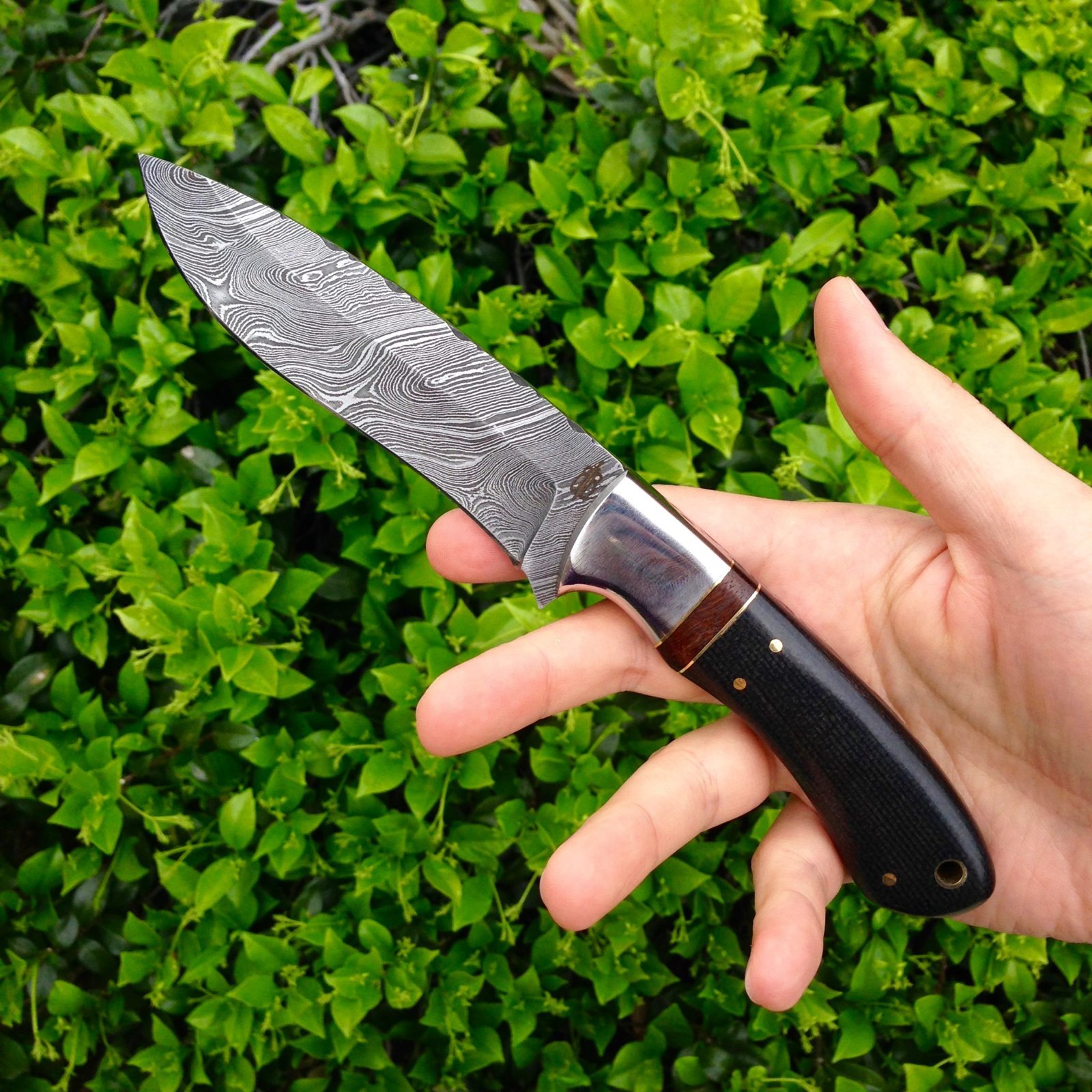
On a real Damascus knife, the pattern runs through the steel, not just on the surface. If you look at the blade’s spine, edge, or tang, you should see the same layers as on the flat side. Fakes often have patterns only on the flat sides and not on the edges.
Pattern Complexity
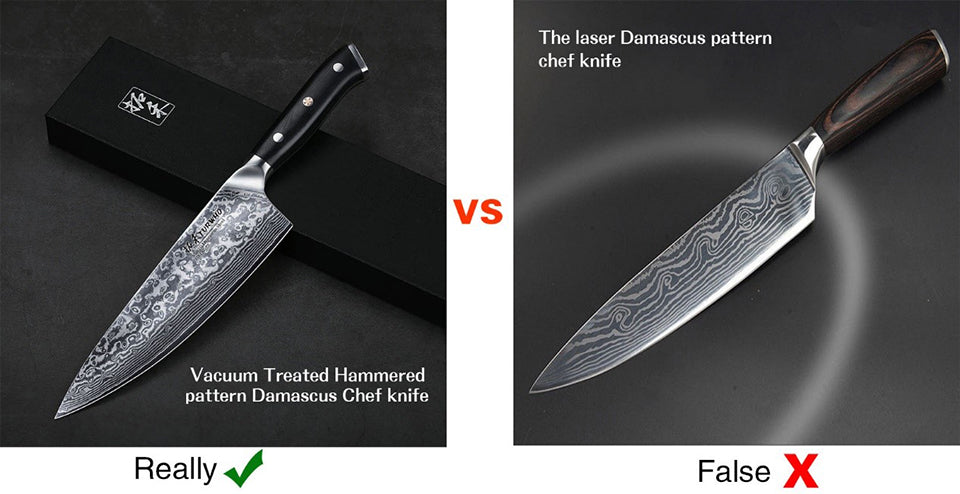
Real Damascus patterns are often complex and organic—they flow naturally and can have swirls, waves, raindrops, or ladders. Fake patterns tend to look too regular or “printed,” with repeating or pixelated shapes.
Surface Feel
When you run your finger across a real Damascus blade, you may feel slight texture from the layers, especially before polishing. Fake knives with etched or printed designs often feel perfectly smooth.
Etch Depth
The acid etching on a real Damascus knife creates a slight relief—the layers are not only visible but can be felt. On fakes, the pattern is usually only a surface effect, with no real depth.
Pattern Consistency
Check the tang (the part of the blade inside the handle) and any exposed parts of the knife. The pattern should continue without interruption. If the pattern stops at the edge, it’s likely not real Damascus.
Comparison Example
Here’s a comparison between real and fake Damascus patterns:
| Feature | Real Damascus | Fake Damascus |
|---|---|---|
| Pattern Location | Visible on all surfaces, including spine and tang | Only on flat sides, often missing on edge/spine |
| Pattern Depth | Can feel slight texture; pattern is deep | Surface only; feels smooth |
| Pattern Complexity | Natural, flowing, unique | Repetitive, regular, sometimes pixelated |
Credit: turwho.com
Practical Tests You Can Do At Home
You don’t need advanced equipment to check if a knife is real Damascus. Here are steps you can try safely:
Check The Spine And Edge
Look at the spine (top of the blade) and the cutting edge. Do you see the same layered pattern as on the side? On a fake, the pattern usually does not wrap around.
Use A Magnifying Glass
A magnifying glass can help you see if the pattern is truly part of the steel. If you see tiny dots, printed lines, or pixelation, it is likely fake. Real Damascus shows continuous, smooth layers.
Light Test
Hold the blade up to a light. On some real Damascus knives, the pattern will shift slightly as you tilt the blade, because the layers reflect light differently. Printed patterns will not change.
Scratch Test (with Caution)
If you own the knife and don’t mind a tiny mark, you can gently scratch a hidden spot with a pin. If the pattern disappears, it’s only surface-deep. If it continues, it’s real.
> Note: Only do this on a knife you own and in a place that won’t affect its use or value.
Acetone Test
On some fakes, the pattern is painted or inked. Dab a little acetone (nail polish remover) on a cloth and rub a hidden spot. If the pattern comes off, it’s not real Damascus.
The Truth About Acid Etching And “damascus Pattern” Knives
Many knives are sold as “Damascus” but are only acid-etched. This means a pattern is applied with acid to a plain steel blade. While acid etching is used on real Damascus to bring out the pattern, on fakes, it’s used to create the pattern where there are no layers.
How To Tell
- If the pattern does not match the layers on the spine or tang, it’s likely only surface-etched.
- Acid-etched patterns can look convincing, but they’re usually very regular and repeat across many knives.
Etched Vs. Pattern-welded
Here’s a quick comparison:
| Type | How It’s Made | Durability | Value |
|---|---|---|---|
| Pattern-Welded Damascus | Multiple steel layers forged together | Pattern lasts as long as the knife | High |
| Acid-Etched Damascus | Pattern applied to surface only | Pattern can wear off | Low |
Understanding Modern Damascus Vs. Historical Damascus
People often confuse historical Damascus with modern versions. The original Damascus was made with wootz steel from India and Sri Lanka. Its formula was lost in the 18th century.
Modern Damascus is made by pattern welding, which gives similar beauty and performance, but is not exactly the same as ancient Damascus.
Key Differences
- Wootz Damascus: Made from a crucible process, now lost. Rare and found only in museums or old collections.
- Modern Damascus: Made from forging and folding layers. Available today from skilled makers.
Both types are valued, but true wootz is almost impossible to buy today. Most “real Damascus” refers to pattern-welded steel.
What To Ask Sellers Before Buying
A trustworthy seller should be able to answer questions about the knife’s construction. Here are things to ask:
- What steels were used? Real Damascus uses two or more steels.
- Is it pattern-welded or just etched? The answer should be clear.
- Can I see photos of the spine and tang? This helps you check for pattern continuity.
- Who made the knife? Reputable makers are usually proud to share details.
- How thick is the blade? Some fakes use very thin overlays.
If the seller is vague or avoids details, be cautious.
Common Myths And Mistakes About Damascus Knives
Many people believe things about Damascus steel that are not true. Here are some myths and the facts:
Myth 1: All Wavy Patterns Are Damascus
Fact: Many knives have wavy designs, but only pattern-welded steel is true Damascus.
Myth 2: Damascus Is Always Super Expensive
Fact: While real Damascus costs more, there are affordable options from smaller makers. Price alone does not guarantee authenticity.
Myth 3: Damascus Never Rusts
Fact: Damascus steel is often not stainless. It can rust if not cared for, especially if one of the steels is high-carbon.
Myth 4: The Pattern Means High Performance
Fact: The pattern is mostly visual. Performance depends on the steels and heat treatment, not just the look.
Myth 5: All Damascus Is Handmade
Fact: Some factories produce pattern-welded steel in large batches. Handmade knives are special, but not all Damascus is made by hand.
Handling And Testing Real Damascus Steel
If you have the chance to hold the knife, there are more ways to check its authenticity:
Weight And Balance
Real Damascus knives often feel solid and well-balanced. Fakes may feel lighter or have uneven weight because of thin overlays or poor materials.
Edge Retention
True Damascus steel often has excellent edge retention due to the mix of hard and tough steels. If a knife dulls quickly, it may not be genuine.
Microstructure
If you have access to a microscope, real Damascus will show alternating bands of different steels. Fakes will show only a single type of steel under the pattern.
Sound Test
Tap the blade gently with a fingernail. Real Damascus often has a clear, bright ring, while cheap fakes sound dull. This is not a perfect test but can help.
Comparing Price, Sources, And Value
Price and source are big clues to authenticity. Here’s what to watch for:
Price Range
Genuine Damascus knives usually start at around $100 for small blades from reputable makers. High-quality custom knives can cost several hundred or even thousands of dollars. If a “Damascus” knife is selling for $20-40, it is almost always fake or acid-etched.
Source Reliability
Buy from trusted sources:
- Reputable knife shops
- Known brands
- Directly from makers
Avoid marketplaces with vague listings or no return policy.
Value For Money
Remember, a real Damascus knife is an investment. It holds value, lasts longer, and often comes with a maker’s guarantee.
Here’s a price comparison for different Damascus types:
| Type | Average Price | Authenticity Risk |
|---|---|---|
| Pattern-Welded (Custom) | $200 – $1,000+ | Low if bought from reputable sources |
| Factory Pattern-Welded | $100 – $300 | Medium; research brand carefully |
| Acid-Etched/Printed | $20 – $100 | High; often misrepresented |
Recognized Brands And Makers For Real Damascus Knives
If you want to be sure, buy from brands or makers with a reputation for real Damascus steel. Some respected names include:
- Benchmade: Offers real Damascus in some special models.
- Boker: German brand known for pattern-welded blades.
- Shun: Japanese knives with Damascus-clad layers over hard steel.
- Al Mar Knives: Some models use real Damascus.
- Custom makers: Many skilled blacksmiths create one-of-a-kind Damascus knives.
Always check reviews and maker information before buying.

Credit: www.coldland.ca
Red Flags: Signs Of Fake Damascus Knives
Here are warning signs that a knife is not real Damascus:
- The price is much lower than average.
- The pattern looks too regular or identical to other knives.
- The seller avoids technical questions.
- The pattern does not continue onto the spine or edge.
- The knife is sold as “Damascus style” or “Damascus look.”
- The brand has no reputation or clear history.
If you see these signs, be extra careful.
Non-obvious Insights Most Beginners Miss
Many first-time buyers focus only on the pattern, but miss other signs of authenticity. Here are two important insights:
1. The Importance Of The Heat Treatment
The performance of a Damascus knife depends not just on the layers, but on the heat treatment. Even real Damascus can be weak if not properly hardened and tempered. Skilled makers pay as much attention to this as to the forging.
2. The Role Of The Core Steel
Some modern Damascus knives are clad—they have a core of high-quality steel (like VG-10 or AUS-8) with pattern-welded layers only on the outside. These knives can still be excellent, but the cutting performance depends mainly on the core, not the Damascus layers. Always ask about the knife’s construction.
Caring For Real Damascus Knives
If you own a real Damascus knife, proper care is important:
- Keep it dry: Damascus can rust if left wet.
- Oil the blade: A light coat of mineral oil prevents rust.
- Avoid dishwashers: Wash by hand and dry immediately.
- Sharpen carefully: Use a fine stone, not a pull-through sharpener.
- Store safely: Keep in a dry place, not a leather sheath for long periods.
Proper care keeps the pattern bright and the edge sharp.
Why Authenticity Matters
Buying a real Damascus knife is about more than just looks. Genuine Damascus steel offers:
- True craftsmanship
- Long-lasting value
- Unique beauty
- Better performance (if properly made)
Fake knives may look good at first but often disappoint in use and have little resale value. Authenticity also supports skilled makers and keeps the craft alive.
Where To Learn More
If you want to study the subject in depth, read about Damascus steel history and science on reputable sites like Wikipedia.
Frequently Asked Questions
What Is The Easiest Way To Spot A Fake Damascus Knife?
Look at the spine and edge of the blade. If the pattern is missing or looks different from the sides, it’s likely not real Damascus steel. Also, check for perfectly regular or repeating patterns, which are common signs of fakes.
Is Acid Etching Used On Real Damascus Knives?
Yes, acid etching is used to highlight the natural pattern of real Damascus steel. However, some fakes use acid etching to create a pattern on plain steel, with no real layers underneath. The key is whether the pattern goes through the steel.
Are All Real Damascus Knives Expensive?
Not always. While custom Damascus knives can be costly, some factory-made or smaller maker knives are more affordable. Be careful with very cheap “Damascus” knives, as they are often fake or only acid-etched.
Can Real Damascus Knives Rust?
Yes, real Damascus can rust if made with high-carbon steels. It’s important to keep the blade dry and oiled. Some modern Damascus uses stainless steels, but these are less common.
Should I Buy A Damascus Knife Online?
You can buy online, but only from trusted sellers with clear photos and detailed descriptions. Ask questions about the blade’s construction, and check for a return policy. Avoid deals that seem too good to be true.
A real Damascus knife is a treasure for any knife lover. With the right knowledge and careful checks, you can find a blade that is both beautiful and authentic—something you’ll be proud to own for years to come.
Credit: blog.knife-depot.com